Showing posts with label castles. Show all posts

Monday, June 20, 2016

escape from castle wolfstein

St. Michael's, Schwabisch Hall
Our way back from Strasbourg wasn’t nearly as nice as the way there. After seeing all the villages of the Alsatian countryside, we were a bit spoiled on beautiful villages, so we didn’t care much for stopping for the Bavarian roadside attractions. But rest stops were in order for the 5-hour drive, so we did decide on a couple. The first stop was going to be Schwabisch Hall—neither of us had ever heard of it, but it certainly had a fun name to say and the visit would include a huge fortified monastery—and the next was to be Neumarkt in der Oberfalz, which we had passed on several occasions, so it had a something of a “why not?” quality to visiting there. The pictures of the town looked nice enough and if our visit to Nordlingen could be a judge of Bavarian towns, then there was sure to be at least some ice cream available.

Schwabisch Hall

Schwabisch Hall is located at about the halfway point between Strasbourg and Nuremberg. For short, locals call the name Hall, giving it something of a Tolkien feel to it—though this was actually its earlier name, as the Schwabisch part wasn’t thrown on until the Nazis. Hall was built on the steep valley walls of the Kocher River in the 5th century and expanded as a salt production center. It now serves as a university town, much like the nearby city of Tubingen.


A channel off the Kocher

We parked our car on the East side of the slowly meandering river, in a garage that appeared to be a half-timbered house from the outside. The wood-roofed pedestrian bridge took us to a small island where there’s a beer garden and a scaled-down replica of Shakespeare’s Globe Theatre, where they must do scaled-down versions of his comedies and tragedies. It’s a fantastic view from the beer garden, seeing the old stone walls holding the city above the Kocher and the houses hanging over the walls. 

On the other side of the river, there’s something of a switch back road, walled on either side by towering half-timbered houses, until at last you reach the main square with the 15th century St. Michael’s Church high up on a storm of stairs—the Freilicht Spiele, used as an outdoor theatre since 1925—and opposite and much lower, the 18th century city hall.


View from St. Michael's

The best times to visit Hall are on Whitsunday (the seventh Sunday after Easter) for the Cake and Source Festival, where some 500 people dress up in costume for the salt mine cleaning ceremonies that have been going on for some half a millennium. Then there’s the International Muzzleloader Shooting festival, which is enough to make any American-liberal-worried-overmuch-about-cultural-appropriation blush quite red in the face. At this festival, there’s a bunch of Germans who are celebrating the American Wild West by dressing up as Native Americans, sleeping in teepees, and having a musket shooting contest. This weird awesome sounding fest isn’t complete without country music bands and cowboy boots for sale.

Comburg Monastery

If you get at just the right angle from the island, you can sort of make out a castle on a hilltop up the valley. Otherwise though, you could visit Hall without even knowing there was a massive castle-monastery a 3-minute drive away. The monastery was founded back in the 1070s by the Counts of Comberg-Rothenburg on the site of their castle. The monks there were all of noble birth, the rejects of the family that didn’t fall in line with primogeniture and whose father’s thought it best that they at least become esteemed maesters of the royal families. Wait – no I’ve got my real history mixed up with my Game of Thrones again. Or vice versa. But really, that sort of thing actually happened. Making your other sons monks did have a way of settling squabbles of inheritance.


The entrance of the monastic castle

The monastery was secularized in the early 19th century and is now used as a teaching school, where they have various teachers’ conferences year round. It would certainly be pretty awesome to have a week long training conference in a castle! I’m waiting for my company to get around to doing one of those…

The outer courtyard

Neumarkt in der Oberfalz

Finally, our driving adventure brought us to Neumarkt in der Oberfalz. Despite being founded in 6th century AD, Neumarkt looked as though it were only just built. Clean streets, freshly painted and built houses, the town looked like it had recently underwent a renaissance. The streets were quiet and nicely paved with a large and busy town center. The town is mostly famous for its Nazi past—Dietrich Eckart, one of the founders of the party, was born there and one of the first local chapters of the country formed there.


the town gate from the main parking garage

The most interesting site in the town we had to miss though, since we were pretty ready to end our trip and get back to the regularly scheduled program in Prague. We could see Bergruine Wolfstein as we passed on our way back to the autobahn, its crumbling towers standing over us. The place has supposedly been pretty incredibly renovated, so I regret that we didn’t get to stop, but home was waiting.

the town square


Tuesday, December 15, 2015

the Castle and the old town festival of Nuremberg

The Castle from Am Olberg street
From the last blog, we went around Nuremberg from the trainstation to the Tiergartentor, one of the prettiest and oldest-feeling squares in all of Nuremberg, with its tall stone tower, it's stone tunnel of a gate, and its medieval cottage style buildings crammed together. When I was there with my parents, we went to my favorite spot for coffee and strudel: Kuchlbauer's Gastehaus. As it was already cold on that cloudy and wet September day, my mom was wanting some mulled wine and my father and I - being that it wasn't noon yet - were looking out for some coffee. 

"Haben sie gluhwein?" I asked for mulled wine. 

"Was?" was the response from the waitress. "What?"

"Gluhwein?" I said, trying to pronounce it a different way. And again. And again. Finally she understood. 

"Ja ja," she said. 

"Und zwei kaffee," I said. "Haben sie americano?"

"Was?"

"Espresso lungo?" 

"Was? Espresso?"

"Nein, nein, espresso lungo. Um, kaffee mit wasser. Lungo. Americano."

"Was? Espresso?"

This clearly was not working.

"Fine, ja, ja." I gave up and ordered my dad and me some espresso, then went off to the restroom. When I came back up, there was a glass of red wine in front of my mom - not hot red wine, just red wine - and two espressos. Another family came in and had been served americanos, what I was trying to order. I scratched my head. Later the mystery had been unraveled - what internationally is usually known as an Americano, and what some places, like in Italy, might call an espresso lungo, they call in Germany a cafe creme. Won't make that mistake again. But despite this difficulty, the cafe remains a goto place for me, simply because of the beautiful interior and atmosphere.

From the Tiergartentor, there are two ways to continue to the castle. You can go through the city gates: a long tunnel through the city walls that winds around the moat and then another entrance in the back side of the castle complex or you can go to the main castle gates by following the staircase behind the Zum Albrecht Duhrer (or the more common path down Obere Shmiedgasse). The advantage of the moat path is that you get to see the weird little gardens down below in the greenery of the moat where locals have allotments and tend to vegetable gardens. The other path takes you above Nuremberg where you get to climb up the steep driveway of the castle and then look out over the city. Generally I prefer this path, since its more of an epic and grandiose entry into the castle, and then taking the moat path on the way back.
The Castle from the tower
The imperial castle was built back in the days back when Nuremberg was an Imperial Free City of the Holy Roman Empire. Truly, those were its glory days, when each emperor would always convene their first Diet in the city and in the Emperor’s absence the mayor got to rule the sprawling city in his stead, with no other feudal powers overseeing him. The museum itself I had been to before and there honestly isn’t much there to enjoy. It has a wonderful exhibit on the history of the Holy Roman Empire and of Nuremberg’s place in it, but you can learn the same from a history book or Wikipedia. The original building received a lot of damage from the Allied bombing campaign and the only building to survive its true form was the chapel, which is admittedly quite a gorgeous piece of stone work with three levels and a center well, allowing for the Emperor to attend mass in a nice, heated room above the second floor, undisturbed by the filthy peasantry that chose to attend down below. 

Inside the chapel
From the castle we walked down the Burgstrasse, passing on the left the nice ornamental courthouse which was not the one made famous after the fall of Nazi Germany, where the famous Nuremberg trials were held. That one is the Palace of Justice, just outside of the old town, about a 15 minute walk away. The notorious room can still be toured, but only at very specific times, since it is still an active courtroom. The furniture has all been replaced and really, there’s nothing original there, but you get to at least see the same walls that the defendants were staring at as they were condemned to death for their war crimes. Finally we made it to the Hauptmarkt, which was the main town square, with its Schoner Brunnen standing as a crown over the city. The Schoner Brunnen – literally “Beautiful Fountain”, the Germans weren’t so creative on names – was built in the 14th century and is adorned with the symbols of the Holy Roman Empire.

At the head of the Hauptmarkt is the Frauenkirche, the weirdly small and country-chapel like, yet Gothic, Catholic church built in the 14th century. I say weirdly small because from the outside it doesn’t really look that large. But once you enter, it seems fairly large, like a brick built Gothic TARDIS, but the only time travel here is in the feeling of antiquity. Most of the statues were restored after World War II, but you can at least glimpse where many of the imperial ceremonies were held in Nuremberg from the time of Charles IV and onward, and this is where the Emperor Charles IV had his son baptized. 

The Frauenkirche and Old Town festival
Also at the Hauptmarkt is where most of Nuremberg’s cultural festivities are held. In the winter, this is where the sprawling Christkindlmarkt is. But as this was in October, we were there for the Old Town Festival, thinking that this would be Nuremberg’s version of Oktoberfest. It isn’t. If you’re reading this thinking about going, then let this blog be a great let down to you. The Old Town Festival is a giant flea market, with various crafts and junk made in China and Turkey for sale. You can get things from gloves, to purses, to jackets, to spatulas here. There really was no consistent theme, and unfortunately it was equally lacking in beer. No beer. Anywhere. I was baffled. How could there be a German festival without beer? How useless! Unless you are looking for a cheap plastic spatula made in China. After our fierce and frivolous search for beer, I apologized to my father and we headed up the Konigstrasse, which was curiously lacking in pubs or bars. As our last ditch effort to have a beer before catching our bus back to Prague, we went back to the cutsey medieval looking Handwerkhof, where unfriendly women in dirndls with overflowing breasts slammed beers down on our table, the frothy head dripping over, down the sides of our plaster steins. Finally, a place to rest and relax, before getting on the 4 hour DB bus, direct to Prague.


Monday, November 2, 2015

on the death of a king and the birth of legends

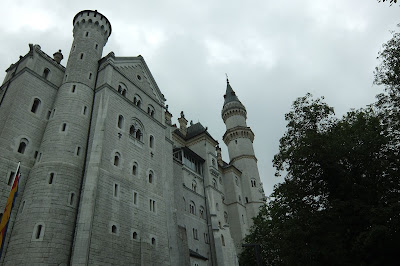
Neuschwanstein peaking from the morning mists
In the middle of a continent that was torn apart by war and itching for more, one sundered by revolutions and dangerous waves of idealism lighting the fires of chaos in the open ovens of taverns and salons, there was one king who held himself quite aloft from everything. While Bismarck was dumping millions of marks into the development of his military and the modernization of his riflemen to make his infantry supreme, another German leader was much more concerned with the development of the arts – and indeed, to show an excellent example of the ultimate triumph of the arts over warmongering and Realpolitik, there lived one mad Bavarian king, Ludwig II. Everybody knows the things that Ludwig touched and held high, whether it’s from the original Disney castle perched high in the Bavarian Alps, or Richard Wagner, the man of his obsession who otherwise would have fallen along with the heaps of other obscure authors, poets, and musicians of that period. And let’s not forget Bavarian culture as a whole, made powerful, momentous, and memorable because of the efforts of that one man, who instead of buying new needle point rifles for his army created armies of musicians to go out and win the world through the heavenly sound of horsehair drifting across catgut.

Of course, we can’t fool ourselves here, there was much value in Bismarck’s military obsession and his sheer ability to make a fool out of all who opposed him. He pressured Napoleon III’s unprepared military into declaring war on him, then – through a great deal of other political machinations, created a vast German Empire that swallowed up all the other German speaking provinces and that would tilt the period’s beloved balance of power, sending Europe into an eventual spiral of paranoia and treaty-signing that would lead to World War I. He held the use of “iron and blood” far above that of democracy, and as one whose goals were to make the German Empire into continental domination, he was successful, but at a future cost that would be much greater. After the pivotal Prussian-Austrian War, Bismarck was able to garner control of all of northern Germany in a single, lightning war – the first time the term “blitzkrieg” would come to use, but not the last. In addition, Bavaria became a mere tribute state, and the once powerful Austrian Empire a mere vassal, living now under “The Misery of Austria”, and whose later Emperors were to be considered buffoons.

View of Hohenschwangau from Neuschwanstein
It’s that world that Ludwig II grew up in, one where the new kingdom of Bavaria was trying to find its place between hugely powerful Empires that were bent on gobbling up the rest of Europe like a feast on a holiday, each participant poking each other with forks under the table while pretending to be civilized gentlemen on the top side. Ludwig was the son of the King of Bavaria, Maximilian II, who himself was keen on the arts and historical studies, having once declared that he would have preferred to have been born a professor than a king. As a king, he was caught in the constant struggle between Austria and Germany over who had the right to rule the German people – a question that would not be answered until his son’s reign – with Bavaria, as a Catholic state, supporting Austria’s claim. As a lover of the arts, he constantly had a coterie of artists around him and rebuilt Schwangau Castle, later to be called Hohenschwangau – or the High Swan County Castle. Hohenschwangau, designed by the German architect and stage designer Domenico Quaglio the Younger, was built in neogothic style and is reminiscent of Crusader castles from long ago, with battlements along the high walls of the house. 

The view Ludwig had imagining his future castle
Ludwig II spent much of his childhood with his brother Otto in Hohenschwangau, surrounded by artists, scientists, philosophers and other friends of the king. There he developed his own love of the arts, often ignoring his princely duties to study politics and how to run a kingdom, partly because the King and Queen seemed to have no real interest in either of their children. Perhaps he thought his father would live forever to work on that, but he had a shock in his 18th year, when his father passed away and he inherited the throne. He was at first energetic with the idea of pushing the arts as a matter of policy, creating his army of musicians and – as his first real act as king – inviting the then reviled Richard Wagner, who was living in poverty and hiding, being a democratic revolutionary in Bismarck’s land of autocracy. Wagner came to live in Ludwig’s household, causing great strain in his family, as Ludwig’s uncle, Luitpold, saw him as a negative influence on the kingdom. Luitpold saw the future of Bavaria with Prussia, which was not compatible with Wagner’s own drama. Yet of the two, it was Wagner who would create an immortal Germany, propelling German folk stories into a real German Myth.

Ludwig was obsessed with Wagner’s operas, an obsession that would never go away. At one point, when Wagner was being driven out of Bavaria by the Parliament led by Luitpold, Ludwig told him that he would rather abdicate and join Wagner – but Wagner refused this offer. It was under Wagner though that Ludwig was the closest to creating a real Bavarian power. At Ludwig’s announced wedding of fellow Wagner fan, Duchess Sophie Charlotte of Bavaria, who was the youngest sister of Austria, Napoleon III would come as a guest, and this would solidify the notion to the people that German unification with Prussia was out of the question. But without this tripartite, it would be impossible to sway the people against Bismarck and a unified Germany. He wrote a letter to Sophie announcing they would not get married, in it, stating “the main substance of our relationship has always been… Richard Wagner’s remarkable and deeply moving destiny.”

It was true. Especially since Ludwig was a bit of a dandy. Not just because he liked the arts, but because he also liked thespians. Male ones. But he also insisted that he would remain true to his Roman Catholic faith, so despite having several male companions, never seemed to have consummated his love for any of them.

The cancellation of the wedding though gave power to his uncle to drive Wagner out. At this time, Prussia and Austria finally moved on the inevitable machine of war, sucking Bavaria into the chaos on Austria’s side. But Bavaria wasn’t prepared, with Bismarck and his allies having just reorganized and modernized Prussia’s military. Bavaria was crushed and forced to submit to Prussia, remaining a kingdom in name only. This defeat led both Ludwig and his brother – who served as a leader in the military – into insanity and obfuscation.

Ludwig would become a recluse, holing up in Hohenschwangau, preferring to live his life as though he were in a fantasy kingdom, with him as an absolute monarch, modeling his life around his servants after the French absolutist king Louis XIV and even seeking to build a scale model palace after Versailles, and calling himself the “Moon King” opposite Louis’s title of the “Sun King”. To supplement this name, after his self-exile, he began to only work at night, and would take carriage rides through the moonlight, calling upon his villagers.

His grander, much more ambitious project was Neuschwanstein, on a mountain peak quite visible from the patios of Hohenschwangau. Neuschwanstain, or “New Swan on the Rock” was the encapsulation of a mountaintop Camelot. It was based off the set design of Lohengrin, who was the Swan Knight in Wagner’s drama, and who was the cause of Ludwig’s initial obsession with the operatic.
Lohengrin's castle realized
Lohengrin is weird story about a guy who comes riding in on a boat pulled by a swan, kills a guy, marries a girl named Elsa, and makes her promise to never ask his name. When she asks his name, he reveals himself as Lohengrin, the son of King Parsifal and a Knight of the Grail, who had sworn to remain anonymous to all of his lovers like some sort of Germanic Casanova. He then decides to leave her and ride back out on his swan. But fortunately, the swan then turns into her brother, but she dies anyway from grief at her husband leaving. Also, the wife of the guy killed earlier turns out to be a witch and she gets killed. But at least Lohengrin is off adventuring somewhere else and marrying other young virgins and Gottfried, Elsa’s sister, is now a Duke. So not everything ends bad that goes bad.

Ludwig grew up adoring this opera and imagining himself as the Swan Knight, while he passed his time below next to the lake that is filled with swans throughout the summer months and while living in his High Swan County Castle. When he became king, he was promoted to being the Swan King and needed a castle fitting as such, so he became convinced in his self-created exile from public life. He would call the castle, New Hohenschwangau, though the name would be later changed after his death. Ludwig sent emissaries out all across the world to discover the beautiful and great, so that he could create castles using a combination of all these good things. Neuschwanstein was a product of this research and glee, its two main inspirations drawing from Chateau de Pierrefonds in Picardy, France, and Wartburg, near Eisenach, in Germany. But Neuschwanstein would far exceed either castle in vision and beauty.

From a nearby promontory
So that the project could be protected from the scheming of his ministers, Ludwig used only his family’s money and borrowed extensively to build his castles, rather than using any of the public treasury funds. Ludwig worked extensively with the architect, Eduard Riedel, to get exactly the image that he wanted. It was a theatrical castle where he could live out his fantasies of being the Swan Knight in seclusion. The interior lacks room for a proper court – which would have been held down at Hohenschwangau – but has an elaborately decorated and designed theatre - the acoustics being of the highest technology of the age - extensive private chambers, and even a room built as a cave, complete with stalagmites and stalactites. All of the art throughout the castle, from paintings to statues to room designs, reflect something to do with one of Wagner’s operas, whether they were of the actual characters, or they were influenced by the set designs.
View of the castle from the village
The house is utterly beautiful but also sadly incomplete. During its construction, an array of ministers who had grown disillusioned with Ludwig’s reign decided to try to depose him and approached Luitpold to lead them, who accepted. They hired a psychologist named Bernhard von Gudden, who despite only having met Ludwig 20 years before, declared Ludwig insane and unfit to rule. They brought Ludwig to Castle Berg as a prisoner and patient, while Luipold ruled as regent. On one day, Ludwig went out with von Gudden for a walk around a nearby lake. Both were found dead in waist-deep water, leaving behind as many conspiracy theories as that which surrounds Kennedy’s death.

After Ludwig’s death, they proclaimed Otto king, who was also insane, so naturally Uncle Luitpold stayed as regent. Luitpold died in 1913 at the age of 91 and was succeeded as regent by his son, also named Ludwig, who then deposed the crazy king Otto and declared himself king. It was a short reign, as World War I started shortly after, bringing a finish to the monarchies of Germany.

Neuschwanstein was never finished and never fully realized its purpose. Shortly after Ludwig's death, the castle with its views of sheer cliff faces, waterfalls, and lakes, became a museum, as it remains today, drawing in 1.3 million visitors every year.

Read my previous blog for some tips in visiting the place.


Wednesday, October 28, 2015

Fussen and something like Disneyland